Consulting
Experience
Expertise in Finance, Accounting & IT
AI, Compass and new possibilities for reporting & planning
With the Q3 2026 release, SAP is expanding SAP Analytics Cloud (SAC), particularly in the areas of artificial intelligence, simulation, visualization, and planning. In addition to new AI-powered features, users will gain enhanced capabilities for scenario analysis and dashboards. At the same time, everyday processes are simplified through Stories and Data Actions.
We provide a concise summary of the most important innovations and their practical added value.
With Q3 2026, SAP Analytics Cloud is expanding its native chart library to include Sankey, funnel, and gauge charts. Gauge charts are particularly well-suited for the concise presentation of KPIs against target or threshold values. Funnel charts visualize drop-off and conversion points within multi-stage processes, such as a sales pipeline. Sankey charts depict flows between categories, with the width of the connections visualizing the respective magnitude. This allows, for example, value flows within a profit and loss statement or budget distributions to be clearly represented. Additionally, the new Quick Builder simplifies the selection and configuration of suitable visualizations.
The main advantages of this innovation:
With Q3, SAP is expanding AI support in Stories with two new features. The AI-Assisted Prompt Insights Widget connects a pre-configured prompt with the context of a table or chart and generates a short, data-driven analysis. This allows, for example, deviations, risks, or unusual trends to be categorized directly within a dashboard. Additionally, AI-Assisted Story Code Generation supports Story Designers with scripting. Users describe the desired logic in natural language and receive a suitable script suggestion, which can be reviewed and adopted in the Script Editor. This enables the implementation of interactive Story features with less scripting effort.
The main advantages of this innovation:
Compass is also being enhanced in the Q3 release. Smart Boundaries allows for the automatic suggestion of plausible upper and lower limits for simulation drivers based on historical data. The results can be displayed as absolute values or relative percentages and adjusted manually if needed. Additionally, a new Compass widget is available, enabling the direct integration of simulation results into regular SAC Stories. Story creators can customize the display and rerun simulations using the widget with updated model data. This allows actual values, planned values, and potential scenarios to be combined within a single story.
The main advantages of this innovation:
With its new Excel-like search functionality, SAP Analytics Cloud improves the selection of dimension elements in filters. Search results are automatically preselected and can then be directly accepted or further customized. The Replace function completely replaces the existing selection with the search result. Update, on the other hand, adds new search results to the current selection while also taking into account any de-selections made within the search. These functions are available in key filter contexts such as story, page, and local filters.
The main advantages of this innovation:
With the new Data Filter parameter, SAP Analytics Cloud introduces an additional parameter type for Data Actions and Multi Actions. This allows multiple dimension filters and input controls to be passed to a single parameter, instead of maintaining separate parameters for each dimension. Supported features include dynamic date ranges, user-defined current date values, attribute-based filters, and explicit exclusions. This enables the filter context of a story to be passed more directly to Data Actions and simplifies the parameterization of more complex planning processes.
The main advantages of this innovation:
The Q3 2026 release brings less of a single major innovation than several features with immediate practical benefits.
The increasing integration of is particularly interesting. AI directly integrated into the development and use of SAC StoriesPrompt Insights and AI-Assisted Story Code Generation show that SAP is not only positioning generative AI as an additional analysis function, but is increasingly integrating it into the daily work processes of developers and business users.
For planning and forecasting, the extensions of [missing information] stand out. Compass as well as the new Data Filter Parameters This highlights the fact that simulations can be more strongly integrated into regular reporting processes and data actions can be more flexibly linked to the respective story context.
Furthermore, SAP is consistently developing the classic reporting experience with new visualizations and minor improvements to search and usability.
Overall, Q3 2026 sets a clear focus: Less manual configuration, more intelligent support, and a closer connection between reporting, planning, and simulation.
INSIRE will gladly support you in using the new functions in a targeted manner and in optimally integrating SAP Analytics Cloud into your existing analytics and planning landscape.
Learn more about SAP Analytics Cloud here.
How subsidiaries benefit from streamlined reporting requirements
The field of international group accounting is currently gaining momentum. One reason for this is the growing realization that the full IFRS in their traditional form creates a reporting burden for certain entities within a group that is disproportionate to the actual information needs of the users.
The IFRS 19 standard, "Subsidiaries without Public Accountability: Disclosures," published by the International Accounting Standards Board (IASB) in May 2024, addresses precisely this issue. It allows qualified subsidiaries to maintain the full recognition and measurement requirements of IFRS while simultaneously preparing significantly reduced notes to the financial statements. For accounting managers in internationally operating groups, this standard offers considerable potential for simplifying reporting processes and system architectures.
IFRS 19 breaks with the previous principle that IFRS users must always fulfill the full disclosure requirements. The key change lies in the strict separation between substantive accounting rules (recognition, measurement, and presentation) and formal reporting requirements (notes to the financial statements):
The extent of the simplifications is substantial: Under IFRS 12 (Investments in other entities), disclosure requirements are reduced by up to 68%¹, and under IAS 16 (Property, Plant and Equipment) by up to 64%². Field tests show that the notes to the financial statements are on average 14% to 19% shorter³. The balance sheet, income statement, and cash flow statement remain unchanged in their basic structure.
In August 2025, the IASB also published a catch-up amendment standard that takes into account recent developments such as IFRS 18 (presentation in financial statements) and the Pillar Two rules under IAS 12 (minimum taxation).
The implementation of IFRS 19 is influenced by several external factors:
Previously, subsidiaries without a capital market orientation faced a fundamental dilemma in choosing their accounting basis. IFRS 19 improves the situation, but does not completely eliminate dual accounting for German entities.
| Criterion | Local Generally Accepted Accounting Principles (e.g., German Commercial Code) | IFRS for SMEs | IFRS 19 (new) |
| IFRS-compliant approach/valuation | No | Limited | Yes (completely) |
| Reduced Appendix | No | Yes (own standard) | Yes (vs. Full IFRS) |
| Group comparability | Low | Medium | High |
For foreign subsidiaries IFRS 19 is reaching its full potential for German corporations: In many jurisdictions, parallel local accounting is no longer necessary, as IFRS 19 can be used as the sole basis for individual financial statements.
For German subsidiaries However, the German Commercial Code (HGB) individual financial statements remain mandatory for tax and distribution-related reasons. The IFRS 19 financial statements, which are disclosed exemptively pursuant to Section 325 Paragraph 2a of the HGB, merely serve as a supplementary disclosure and do not replace the HGB financial statements. Dual accounting thus remains structurally in place in Germany. A change in the law, as recommended by the German Accounting Standards Committee (DRSC), would be necessary to alter this situation.
IFRS 19 is designed as a voluntary option. Its application requires three criteria to be met cumulatively:
Banks, insurance companies, securities dealers, and investment funds are typically explicitly excluded. Furthermore, no relief is provided in three areas: segment reporting (IFRS 8), insurance contracts (IFRS 17), and earnings per share (IAS 33).
Depending on the previous accounting basis, different transitional provisions apply:
Despite the significant simplifications, there are areas that require careful consideration. The concept of "fiduciary capacity" is particularly open to interpretation in the insurance sector. Furthermore, management must assess on a case-by-case basis whether the reduced disclosures are sufficient to provide a fair presentation. If not, supplementary information is required.
IFRS 19 does not fundamentally change the structure of either the balance sheet or the income statement. The main effects are:
The starting point is a structured eligibility screening of all subsidiaries of the group. The three criteria of the scope of application must be examined for each entity, and the current accounting basis must be documented. The next step involves considering the national framework of the respective jurisdiction, in particular distribution and tax accounting regulations.
Based on the screening, a cost-benefit analysis must be conducted for each qualified entity. One-time implementation costs (particularly for those switching from local standards) are offset by ongoing savings in the preparation of the notes to the financial statements and in the group-wide reporting process. This analysis must also clarify the relationship to existing covenants and coordinate with the auditor regarding the materiality of the remaining disclosures.
Based on the assessment, concrete implementation steps must be defined:
In the coming years, IFRS 19 is expected to gain wider significance once formal EU endorsement is completed. For German corporations, the standard will initially be relevant primarily for foreign subsidiaries, as the obligation to comply with the German Commercial Code (HGB) remains in effect domestically. A potential amendment to the HGB, as recommended by the German Accounting Standards Committee (DRSC), could extend its scope to domestic entities in the future.
In parallel, increasing standardization in the consolidation environment (e.g., through SAP Group Reporting and SAP S/4HANA) enhances the technical possibilities for efficiently implementing IFRS 19. New requirements for transparency and data-driven reporting, for example in the context of ESG, will further shape this field.
And finally ...
IFRS 19 is a pragmatic and long-overdue standard that closes a real gap in the IFRS framework. It enables subsidiaries to prepare IFRS-compliant financial statements without having to bear the full disclosure burden of capital market reporting. Compliance with group accounting standards is maintained, the effort is reduced, and comparability within the group is ensured.
The positive market reaction from auditors and companies confirms the practical benefits. It is now crucial to begin structured preparations early in order to fully utilize the opportunities offered by the new standard from the 2027 financial year onwards.
The introduction of IFRS 19 is not only a technical challenge, but also has a direct impact on your ERP and consolidation systems. Typical adjustments are required for the mapping logic in SAP Group Reporting, the notes templates in your financial statement cockpit, and the IFRS 1 first-time application logic for transitioning entities.
INSIRE accompanies you as a specialized consultant in the field Financial Consolidation and SAP S/4 transformation from initial eligibility checks to productive go-live in your consolidation system. Contact us if you would like to structure your IFRS 19 roadmap.
1 IASB, Effects Analysis: IFRS 19 Subsidiaries without Public Accountability: Disclosures, May 2024, available at: https://www.ifrs.org/content/dam/ifrs/publications/amendments/english/2024/ifrs19-effectsanalysis.pdf
² Ibid.
³ Ibid.
In many companies, SAP Analytics Cloud is the central entry point for reporting and analysis. Dashboards and ad-hoc analyses provide standardized key performance indicators (KPIs), defined data models, and a unified view of relevant business data.
At the same time, Microsoft Excel remains an integral part of daily work in many departments. Particularly in finance and controlling, users often continue to rely heavily on Excel for detailed analyses, reconciliations, and short-term evaluations.
Therefore, after a first glance at a key figure, further questions often arise immediately:
This is precisely where a media break often occurs in practice. Data is exported, filters and structures are manually reconstructed, and analytical contexts are lost between systems.
The "Open in Excel Add-In" function from the SAP Analytics Cloud Data Analyzer makes this transition significantly easier.
The starting point can be a simple ad-hoc analysis in the Data Analyzer, for example an evaluation by customers, regions and key figures with a pre-defined filter context.
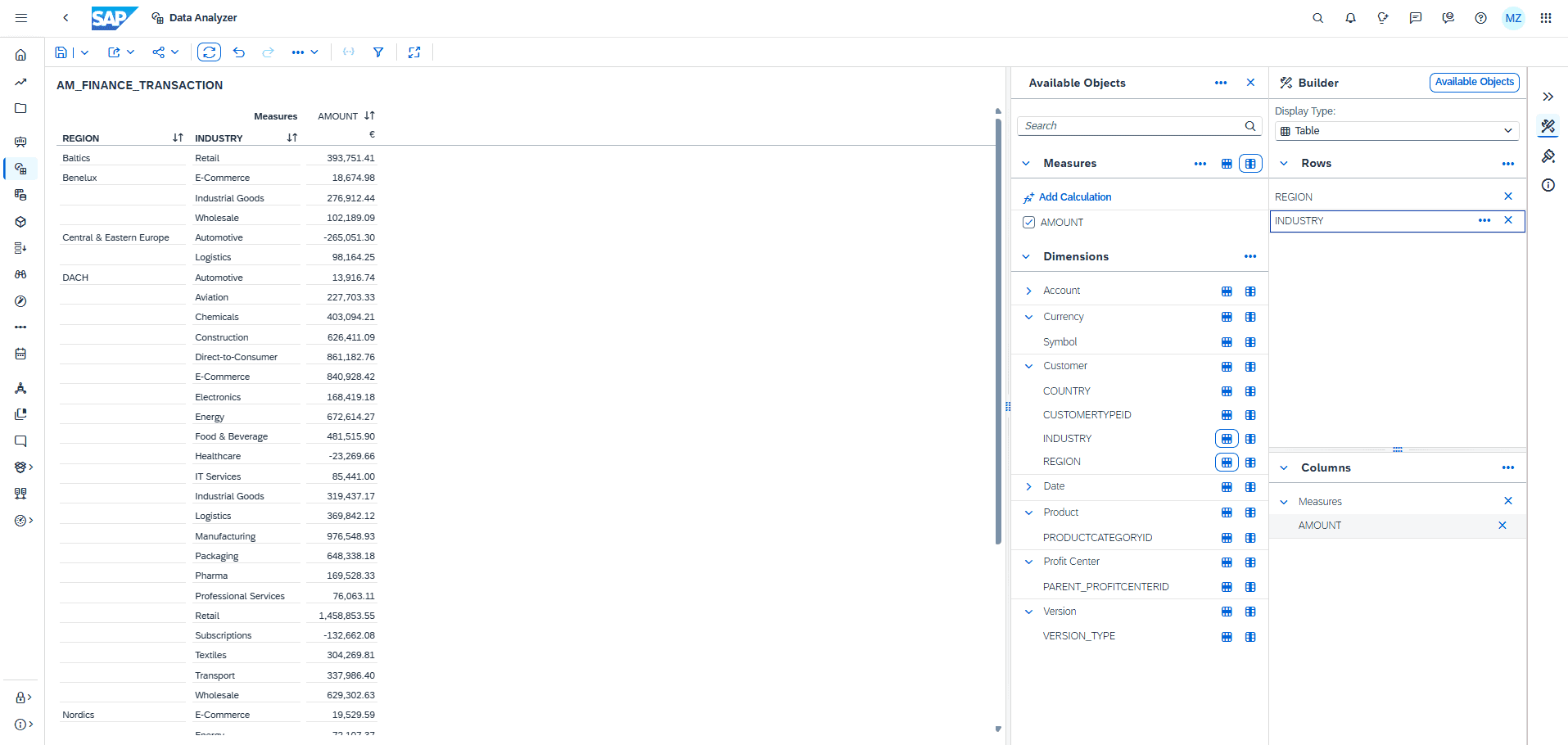
Figure 1: Comprehensive ad-hoc analysis by region and industry in the SAP Analytics Cloud Data Analyzer
About the Export menu This analysis can be performed directly in SAP Analytics Cloud Add-in for Microsoft Excel can be opened. This eliminates the traditional detour via a purely static export.
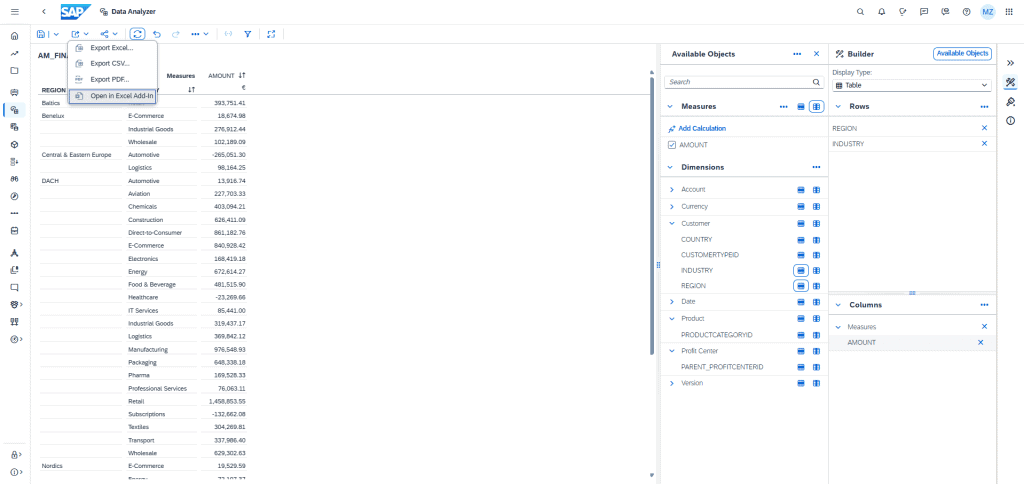
Figure 2: Direct transition via “Open in Excel Add-In” in the export menu of the Data Analyzer
This process doesn't just create one file. Analysis and navigation context Data from SAC is transferred to an Excel workbook. After logging in to SAC Excel Add-in The evaluation can be further analyzed in Excel.
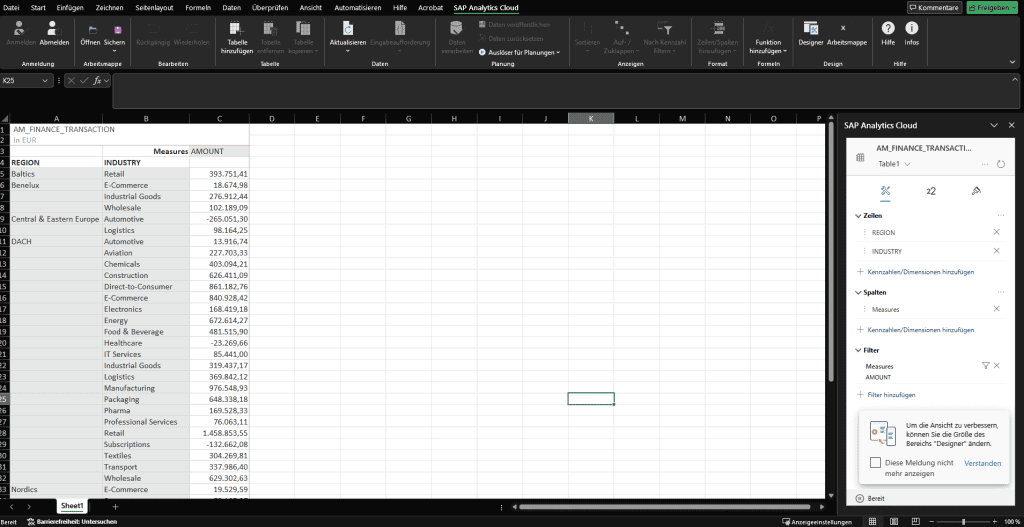
Figure 3: Data Analyzer evaluation imported into the SAP Analytics Cloud Add-in for Microsoft Excel
This is particularly relevant for departments that use SAP Analytics Cloud as their central reporting platform but still rely on Excel for detailed analyses, reconciliations, or individual evaluations. The added value lies not in replacing Excel, but rather in better integrating two established ways of working:
The SAC Excel add-in is relevant beyond reporting. In suitable planning scenarios, Excel can be used as a familiar interface for planning processes, for example, for data entry, adjustments, and working with SAC planning models.
This highlights an important point: modern analytics solutions don't necessarily have to completely replace existing ways of working. Often, the greatest benefits arise when centralized control, governance, and standardized reporting are combined with familiar tools within the business unit.
SAP Analytics Cloud remains the central platform for reporting, analysis, and planning. Excel is integrated where flexible, detailed work within the specialist department is still required.
Because reporting doesn't always end at the dashboard. Often, that's where the next analysis question begins.
SAP Datasphere has established itself as a central component of modern SAP data architectures. Datasphere combines data integration, modeling, and business use in hybrid landscapes, thus creating the foundation for enterprise-wide analytics and reporting scenarios. A key structural element is the concept of Spaces.
However, Spaces are often misused in many projects. What initially appears to be a clean structuring solution can, over time, develop into a difficult-to-manage governance and operational problem. The reason for this lies less in technical limitations than in a fundamental misunderstanding of the role of Spaces in SAP Datasphere.
In practice, spaces are frequently used to separate projects, teams, or individual use cases. A separate space is created for each project to avoid conflicts and seemingly clearly divide responsibilities. As soon as data is needed across these boundaries, objects are shared between spaces.
This approach follows a logic familiar from classic data warehouse architectures. InfoAreas, folder structures, and client-like concepts are transferred to SAP Datasphere. The underlying assumption is understandable, but incorrect.
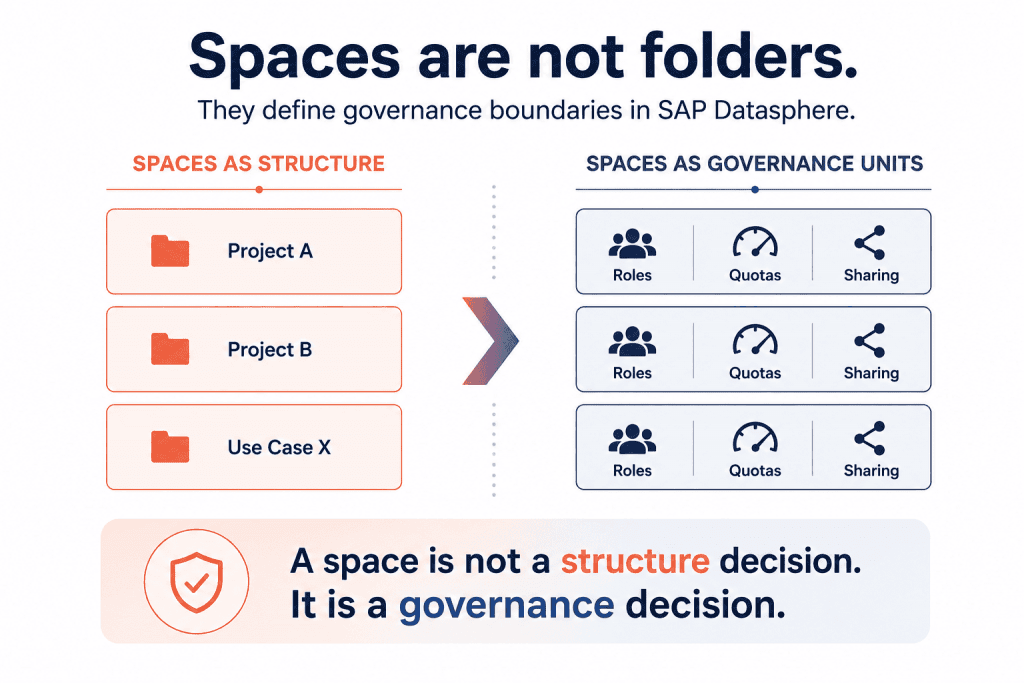
Spaces in SAP Datasphere are not merely logical structuring elements. They are not folders or project containers. Rather, a space defines a governance boundary with concrete technical, organizational, and operational implications.
Creating a space establishes an independent unit with its own security, operational, and resource logic. Each space has separate role structures, its own responsibilities, and defined resource and capacity limits. Furthermore, sharing relationships between spaces are explicitly controlled and managed.
These characteristics are not a side effect of the platform, but rather a deliberate architectural design. They enable clear allocation of responsibility, clean demarcation of data products, and targeted enforcement of governance. However, this requires that Spaces are used with appropriate care and restraint.
Those who primarily use Spaces for organizational structuring create the exact opposite of order in the long run. With each additional Space instance, the administrative effort increases. Roles and permissions have to be maintained multiple times, the need for coordination grows, and changes require ever more coordination across Space boundaries.
This development becomes particularly critical when many objects are permanently shared between spaces. Data models are then technically distributed, but closely intertwined from a business perspective. The original separation loses its meaning, while governance complexity continues to grow. Responsibilities become blurred, as it is no longer clear which space is the business owner of a particular data product.
From an operational perspective, challenges also arise. Resource consumption and costs are more difficult to allocate because persisted data, replications, and transformations are distributed across multiple spaces. Performance problems become increasingly opaque, as dependencies are no longer clearly traceable. The causes then rarely lie in individual modeling errors, but rather in the overall structure of the setup.
These effects are not random. They are a direct consequence of a fundamental misconception in dealing with spaces.
The most common error lies not in the technical setup, but in the mental model. Spaces are used as a means of structuring, even though they define governance boundaries in SAP Datasphere. This leads to decisions about security, operations, and responsibility being made implicitly, without being consciously recognized as such.
Each additional space increases governance complexity not linearly, but disproportionately. Roles multiply, sharing relationships increase, and the effort required for operation and control grows with each additional unit. Those who use spaces excessively don't create a flexible setup, but rather a permanently complex operational and control problem.
A sustainable space concept does not begin with projects or use cases, but with the question of stable responsibility. Spaces should be defined where professional or organizational responsibilities are permanently differentiated and can be clearly defined.
The use of a few, clearly defined space types with a distinct task has proven effective. Modeling spaces are responsible for integration, harmonization, quality, and business logic. Consumption spaces provide tested and approved data products for reporting and analysis. This separation reduces dependencies, increases transparency, and protects business users from unstable intermediate states.
Sharing should be targeted and restrictive. It is suitable for stable, shared data products, but not as a permanent replacement for a clean architecture. The fewer objects that need to be shared between spaces, the clearer and more manageable the overall structure remains.
Crucially, a clear allocation of ownership is essential. For each space, it must be unambiguously defined who is technically responsible, who manages technical changes, and who is responsible for operations. Projects end, but data products remain. This reality should also be reflected in the space structure.
Spaces are one of the most important design elements in SAP Datasphere. Precisely for this reason, they should be used with care. Those who understand Spaces as an organizational or project structure risk long-term governance chaos, increased operating costs, and a lack of transparency.
Those who understand Spaces for what they are – stable governance units with clear responsibilities – create the basis for a scalable, maintainable and operationally manageable Datasphere architecture.
It is not the number of spaces that determines order, but the clarity of the architectural concept behind them.
SAP Datasphere Introduce – structured, secure, with real added value.
Previously, the functions "Copy", "Cancel", "Create", and "Delete" were available for manual group-level bookings. With this new release, the "Replace" function has been added. This is intended to make it even easier for users to modify manual group-level bookings.
The "Replace" function automatically generates a cancellation document for the booking being changed and saves the amended booking record in the system under a new document number. If a booking or its cancellation is subject to a workflow, a workflow item is automatically created. The booking then requires prior approval.
When dealing with bundled documents, replacing one bundle element replaces the entire bundle.
The booking document to be changed is selected in the "Book Group Booking Documents" app. Clicking the "Replace" button then takes you to the "New Booking Document" view.
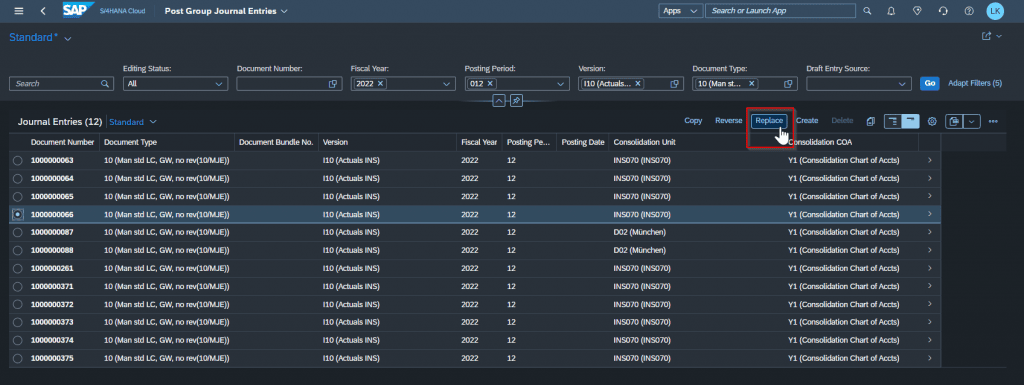
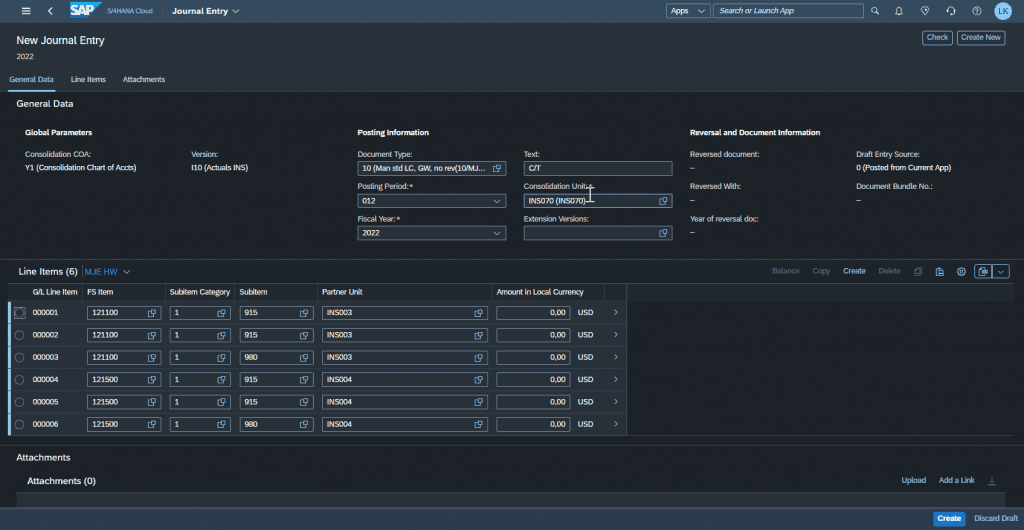
In the "New Booking Document" view, the desired changes can be made to the existing document:
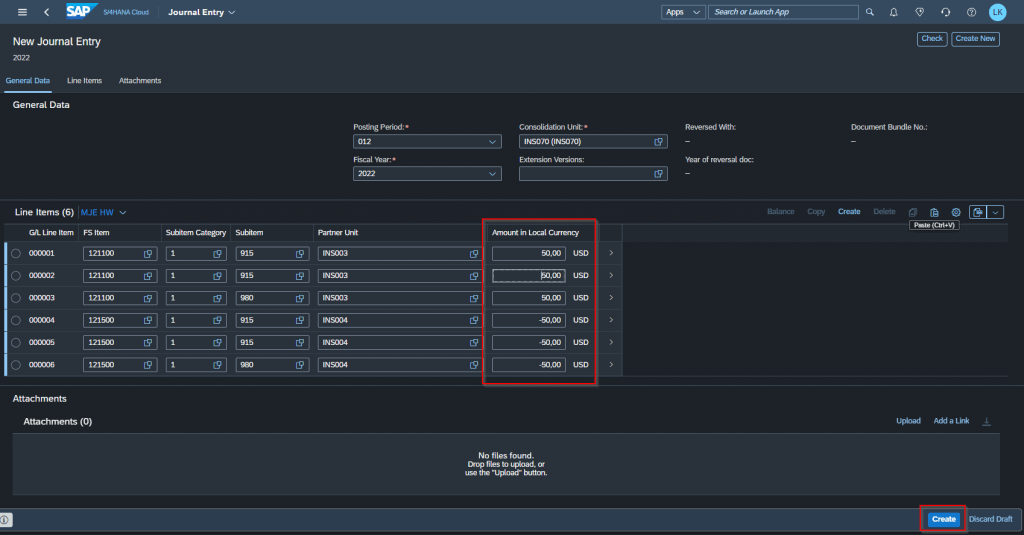
In this example, the amounts in the company currency were changed from 100 to 200 USD. The adjusted booking document was created under the new number 1000000375.
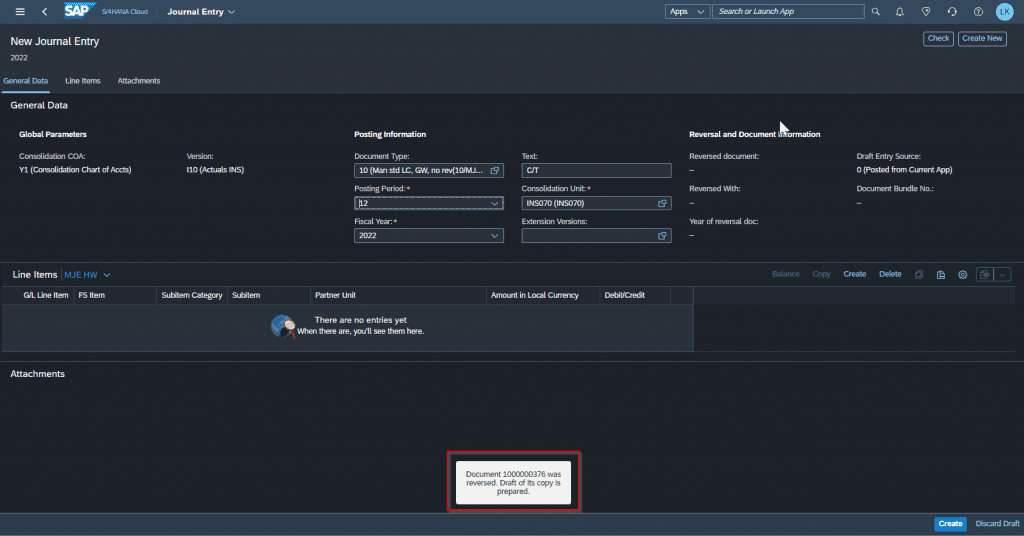
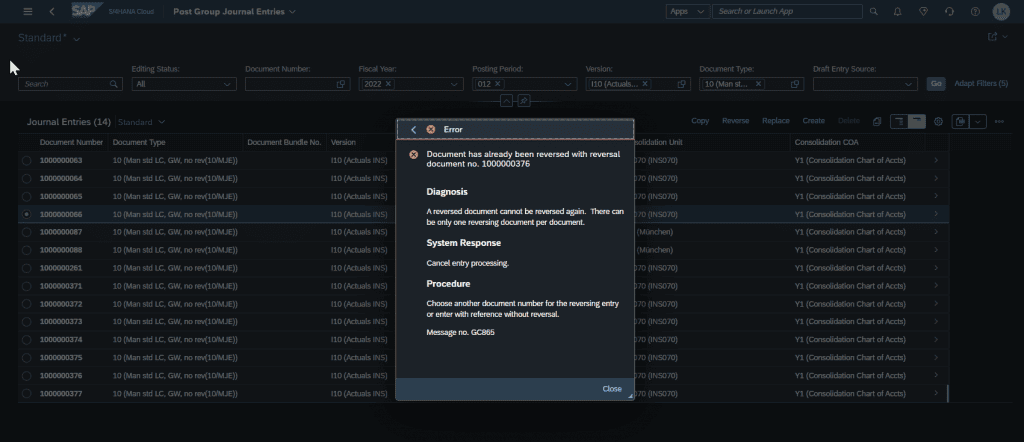
Please note that the cancellation of the selected booking is triggered immediately upon clicking the "Replace" button, even if the change process to adjust the original document via the replace function is not completed but rather aborted during processing!
If the "Replace" button has been clicked for a booking document, but the process is then canceled, the "Replace" function is no longer available for that booking document. The only remaining options are to create the desired change from scratch using the "Create" function, or to use the "Copy" function.
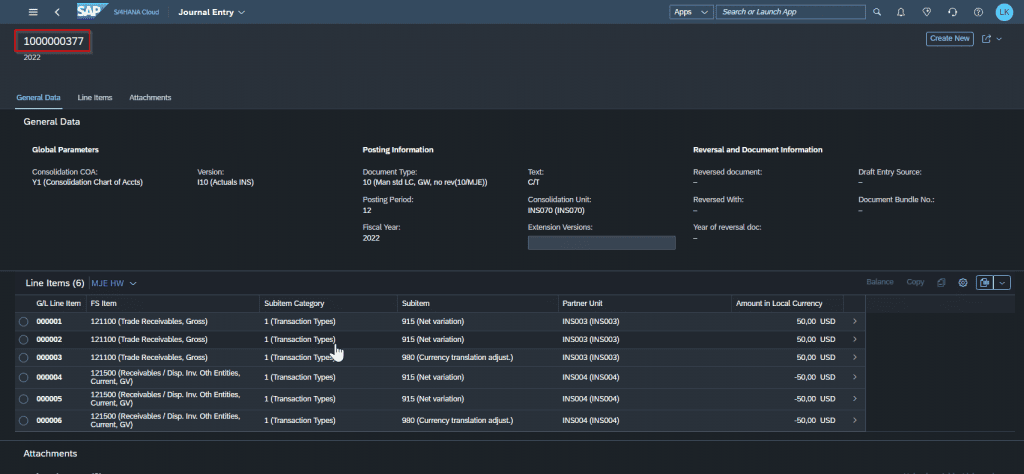
It is recommended that a user-friendly display layout be pre-configured in the "New Booking Document" view, especially for inexperienced users. The SAP standard layout also includes information (e.g., transactional currency) that is sometimes unused and can make the display appear confusing to the user.
With the Q2 2026 release, SAP Analytics Cloud (SAC) expands its functionalities in the areas of reporting, story development, administration, and user-friendliness. The focus is on new options for more flexible reporting, improved development support, and optimizations to the user interface and monitoring.
INSIRE provides a concise summary of the most important innovations and their added value for companies.
With the Q2 2026 release, SAP Analytics Cloud significantly simplifies the implementation of asymmetric reporting scenarios. Different time periods, granularities, and comparison values can now be combined more flexibly within a single table.
This allows, for example, actual values, forecast data, budget figures, and variance analyses to be displayed in a single view. This opens up new possibilities for creating clear and informative reports, especially for rolling forecasts, management reports, and plan-actual comparisons.
The advantages at a glance:
With the new Composite versioning framework, SAP expands the possibilities for managing composite objects.
Developers can save, manage, and restore multiple versions of a composite object as needed. Changes to layouts, filters, or visualizations are thus traceably documented and can be further developed in a controlled manner.
Especially in projects with multiple developers or frequent adjustments, this significantly improves traceability and reduces the effort required for changes.
The advantages at a glance:
The Job Monitor will be expanded with additional monitoring functions in the Q2 release. In the future, data export API jobs and delta calculation jobs can also be monitored centrally.
Administrators gain a better overview of ongoing and completed data processes, as well as additional information on runtimes, processing status, and data volume. The new delta calculation jobs also increase transparency regarding data changes and support the analysis of data movements within the system landscape.
The advantages at a glance:
With the new data panel, SAP modernizes the way data sources are used within stories.
For the first time, the data area is more clearly separated from the layout and styling functions. This gives developers and business users more direct access to models, key figures, dimensions, and calculations. At the same time, navigation between data sources is simplified, and working with multiple models becomes more transparent.
The revised user interface supports both experienced developers and casual users in creating and maintaining stories.
The advantages at a glance:
Starting in Q2 2026, SAP will integrate the "Recent" and "Favorites" sections directly into the open and save dialogs of SAP Analytics Cloud.
This allows users to access recently used or favorited stories, models, and folders more quickly without having to search the entire repository structure. Especially in large SAC environments, this reduces search effort and clicks in daily work.
The advantages at a glance:
With the Q2 2026 release, SAP continues to expand SAP Analytics Cloud. Improvements in reporting, enhanced development capabilities, and optimized user interfaces, in particular, help companies to make their analysis, reporting, and planning processes more efficient.
For business users, this means greater flexibility in creating and using reports. Developers and administrators simultaneously benefit from improved traceability, simplified management functions, and greater transparency in daily operations.
The presented innovations demonstrate once again that SAP Analytics Cloud is further expanding its position as a central platform for planning, reporting and analytics.
INSIRE will gladly support you in specifically evaluating the new functions, identifying their potential for your organization and optimally integrating them into your existing SAC landscape.
Learn more about our SAP Analytics Cloud services now!
Financial closing is one of the most critical recurring processes in finance. Monthly, quarterly, and annual financial statements must be prepared on time, transparently, and in an audit-proof manner – often across multiple accounting units, companies, countries, and ERP systems. At the same time, expectations for transparency, automation, and speed are increasing.
SAP Advanced Financial Closing (AFC) addresses precisely this need for action. The solution supports companies in planning, processing, monitoring, and analyzing closing tasks for the units within a group. This shifts the focus away from manual checklists, Excel trackers, and decentralized coordination towards structured, system-supported closing management.
AFC is particularly relevant for companies whose closing process recurs periodically, involves multiple responsible parties, follows a clear chronological or dependent sequence, and whose status needs to be transparently documented. SAP describes precisely these requirements as typical use cases for financial closing in SAP Advanced. Financial Closing.
In many organizations, the closing process has evolved organically over time. Tasks are planned in local teams, progress is reported via email, and status information is consolidated in spreadsheets. This approach often works operationally, but reaches its limits as complexity increases.
Three developments are currently shaping the closing environment:
SAP AFC supports this development through task plan templates, task plans, dependencies, role and user assignments, and central monitoring and reporting functions. Task plan templates can be used for various closing types, such as month-end or quarterly closing. Furthermore, multiple communication systems can be integrated into a single template, allowing the closing process to be managed across selected systems with a single task plan.
The modernization of financial statements is not solely driven internally. External factors are also increasing the pressure on finance organizations:
SAP AFC is designed as an SAP BTP application and can be connected to SAP S/4HANA Cloud Public Edition, SAP S/4HANA Cloud Private Edition, SAP S/4HANA, and SAP ERP as financial communication systems. OData services are used for SAP S/4HANA scenarios, and a REST service for SAP ERP. This makes AFC particularly suitable for heterogeneous transformation landscapes.
SAP AFC is not a replacement for the actual FI and CO posting logic in the ERP system. The solution orchestrates the closing process through tasks, responsibilities, dependencies, job executions, status information, and reporting.
| Classical approach | basic functionality | Full scope |
| Decentralized Excel checklists | Not active | Active (required) |
| Status updates via email | S/4HANA Standard | S/4HANA Finance for CM |
| Manually starting jobs | Yes (subset) | Yes (completely) |
| Local view of individual companies | No | Ja |
| High coordination effort | No | Ja |
| Limited traceability | No | Yes (including 2FA) |
| Liquidity position | No | Ja |
The added value thus arises less from a single function, but from the combination of process modeling, automation and controllability.
A key component of SAP AFC is task plan templates. These templates represent a company's closing structure and contain header information such as description and time zone. Specific task plans for a closing date are generated and released from these templates.
In practice, this is the crucial step from "lived process knowledge" to a manageable process model. Tasks can be structured according to areas such as general ledger accounting, accounts receivable, accounts payable, fixed asset accounting, or controlling. SAP also provides predefined content based on task plan models that include mandatory and optional closing activities for multiple roles and subledgers.
A clean, technical model is essential for implementation:
SAP AFC allows the definition of predecessor and successor tasks. This enables the mapping not only of a chronological sequence but also of a business-oriented process logic. This is particularly important in the closing phase: Certain reconciliations, valuation programs, or intercompany processes can only be meaningfully carried out once upstream postings or audits have been completed.
Additionally, roles for responsible and executing users can be assigned to either individuals or user groups. This supports shared service models and reduces dependence on individual users.
The following aspects are particularly relevant for governance and compliance:
The greatest efficiency gains are achieved when AFC is not only used as a checklist tool, but also actively orchestrates technical execution. SAP AFC can integrate multiple communication systems into task plan templates and manage completion processes across these systems.
Furthermore, integration options exist with SAP Build Process Automation, BlackLine, and external systems. According to SAP, AFC can be integrated with external systems provided they implement a simple scheduling provider interface. This allows activities outside the central SAP S/4HANA system to be included in the closing process.
Typical automation candidates are:
Realistic prioritization is crucial: not every task needs to be automated. The first step is to identify high-volume, recurring, and rule-based activities.
The full implementation of SAP CLM has far-reaching implications:
SAP AFC makes the closing process measurable. Reporting apps support the analysis of task status, progress, and bottlenecks. This allows managers to see which units are on schedule, where delays are occurring, and which tasks are critical.
This transparency fundamentally changes how the closing process is managed. Instead of subsequent status queries, continuous process monitoring is established. This is particularly valuable for organizations with many company codes, international shared service centers, or multiple ERP instances.
Current discussions surrounding company code groups further demonstrate that the flexible grouping of accounting units is a crucial component for large organizations. Accounting units can be grouped according to criteria such as region, business unit, or organizational responsibility. This allows for a more targeted structuring of closing progress, responsibilities, and reporting – particularly in multinational corporations.
The implementation of SAP AFC is not a purely technical project. It affects processes, roles, governance, and operating models in the finance area.
Key impacts include:
This often makes AFC a catalyst for a broader finance transformation. Anyone wanting to digitize the financial closing process must first understand how it actually works today – including workarounds, local peculiarities, and informal coordination channels.
Before implementing the system, the existing closing process should be systematically recorded:
Subsequently, a technical target image should be developed. This should describe not only the technical use of AFC, but also the future control logic:
A pragmatic approach is usually more successful than trying to fully automate the entire closing process immediately. A phased approach has proven effective:
Since SAP AFC runs on the SAP Business Technology Platform, technical and organizational prerequisites should be checked early on:
In the coming years, financial closing processes will continue to face increasing pressure: shorter deadlines, rising regulatory requirements, greater automation, and higher expectations for transparency. SAP AFC positions itself as a platform for the central orchestration of financial closing – particularly in complex, international, and hybrid system landscapes.
The strategic added value lies not only in digitizing a checklist. Crucially, it is the ability to standardize closing processes across the entire group, integrate them technically, monitor them transparently, and continuously improve them.
INSIRE can help companies to Financial To analyze the subject matter from a technical perspective, develop a viable target vision, and implement SAP Advanced Financial Closing is structured to be integrated into the existing SAP Finance architecture – from process mapping to template design and authorization concept to the automation roadmap.
SAP Advanced Financial Closing processes are gaining increasing strategic importance for finance organizations. The solution creates transparency regarding closing activities, supports the standardization of recurring tasks, and unlocks potential for automation and group-wide management.
However, successful implementation depends significantly on thorough preparatory work. Companies should not view AFC as an isolated tool, but rather as part of a comprehensive finance transformation. Structuring closing processes early on, clarifying responsibilities, and strategically prioritizing automation lays the foundation for faster, more stable, and better-managed operations. Financial Close.
You want to know if SAP Advanced Financial Is closing suitable for your closing organization? INSIRE supports you in evaluating your current closing processes, developing an AFC target image, and deriving a realistic implementation roadmap.
Contact us – together we'll make your Financial Close more transparent, efficient and future-proof.
Comprehensive liquidity management and real-time cash transparency
Managing corporate liquidity is one of the core tasks in finance – and simultaneously one of the areas with the greatest potential for optimization. Heterogeneous system landscapes, manual processes, and a lack of real-time transparency lead to risks in liquidity planning and management in many companies.
SAP Cash and Liquidity Management (CLM) in S/4HANA offers an integrated solution for the centralized management of bank accounts, operational cash management, and strategic liquidity planning. The focus is on real-time capability, process automation, and a modern user experience via SAP Fiori.
In recent years, several fundamental developments have emerged in the area of cash and liquidity management:
The development is further intensified by external influencing factors:
SAP CLM distinguishes between two expansion levels, whose range of functions differs significantly:
| functional area | basic functionality | Full scope |
| Business function FIN_FSCM_CLM | Not active | Active (required) |
| License | S/4HANA Standard | S/4HANA Finance for CM |
| Banks / Main banks manage | Yes (subset) | Yes (completely) |
| Workflow / Four-eyes principle | No | Ja |
| Cash Pooling | No | Ja |
| Approve bank payments | No | Yes (including 2FA) |
| Daily financial status | Basic | Erweitert |
| Liquidity position | No | Ja |
| Current Cash Flow Analysis | No | Ja |
| Liquidity planning / forecast | No | Ja |
| SAP Analytics Cloud Integration | No | Ja |
The BRM forms the basis for a central, workflow-based bank account management system:
The operational cash functions include:
Liquidity management enables:
The full implementation of SAP CLM has far-reaching implications:
In the coming years, the developments described are expected to intensify. New requirements from compliance and reporting, increasing standardization, and rising expectations for real-time transparency will further shape the field of cash and liquidity management.
SAP CLM is continuously being developed – for example, through deeper SAP Analytics Cloud integration and expanded automation options. INSIRE supports you in strategically leveraging its full range of functions and future-proofing your liquidity management.
SAP Cash and Liquidity Management in S/4HANA is far more than just operational liquidity management. It creates transparency, reduces risks, and makes liquidity management an actively controllable business factor.
For companies that want to professionalize their liquidity management, automate processes and build a future-proof SAP architecture, the step from basic functionality to the full scope is a central building block within SAP S/4HANA – and a clear added value for finance, treasury and management alike.
Further insights and downloadable material can be found in our knowledge base.
Contracts are among a company's key economic management tools – and simultaneously among its least transparent. Different contract types, decentralized storage, manual maintenance, and a lack of integration into financial processes often lead to risks, inefficiencies, and unnecessary costs.
SAP Contract and Lease Management (CLM) offers an integrated solution for the centralized management, evaluation, and control of contracts and leases in SAP S / 4 HANAThe focus is not only on compliance with regulatory requirements, but above all on the Sustainable optimization of contract management across the entire lifecycle.
In many companies, contract management has evolved organically over time and is highly fragmented. Typical challenges include:
SAP CLM addresses these challenges through a holistic, systems-based approach, which does not view contracts in isolation, but as an integral part of business processes.
SAP CLM enables the centralized recording and management of a wide variety of contract types – from leasing agreements and service contracts to rental agreements and usage-based agreements. All relevant contract information is maintained in a structured manner within a single system.
The Single Source of Truth This forms the basis for transparency, traceability and audit-proof processes.
SAP CLM supports the entire lifecycle of a contract:
Deadline monitoring and status logic reduce operational risks and prevent unwanted contract extensions or missed deadlines.
A key advantage of SAP CLM is the deep integration in SAP S/4HANA:
This transforms contract management from an administrative side task into a integrated control instrument for Finance and Management.
All contracts are centrally available, up-to-date, and analyzable. Management and specialist departments have a clear overview of obligations, terms, and cost structures at all times.
Automated deadline monitoring, clear contract classifications and complete documentation minimize legal, financial and regulatory risks.
Standardized processes replace manual tasks. Recurring calculations, evaluations, and bookings are automated – resulting in measurable efficiency gains.
Structured contract data enables meaningful reports and analyses, e.g.:
SAP CLM is fully aligned with SAP S/4HANA and is continuously being developed further. New requirements – for example from accounting, compliance or reporting – can be integrated without system breaks.
In addition to operational contract management, SAP CLM forms an important basis for regulatory requirements such as IFRS 16. The clear structuring of contract data and payment flows enables compliant valuation and seamless integration into financial reporting.
This makes contract management not only more efficient, but also audit-proof and compliant.
SAP Contract and Lease Management is far more than just a contract management tool. It creates transparency, reduces risks, and transforms contracts into an actively manageable business factor.
For companies that want to professionalize their contract landscape, automate processes and build a future-proof SAP architecture, SAP CLM is a central building block within SAP S/4HANA – and a clear added value for finance, purchasing and management alike.
Our preview of Disclosure Management provides Lucanet a modern solution for the creation and control of Financial and ESG reports Ready. The platform combines powerful reporting functions with a modern, cloud-based architecture.
As implementation partner We support companies in the Introduction of Disclosure Management Solutions and provide support for, among other things:
Our Goal The goal is not only to implement reporting processes technically, but also to make them more efficient and transparent in a sustainable way.
Disclosure Management provides a powerful platform for the next generation of corporate reporting.
The regulatory landscape for tax reporting and documentation requirements is undergoing profound structural change worldwide. Electronic invoicing, real-time reporting, and standardized data formats are evolving from optional procedures to mandatory compliance standards in many countries. In parallel, SAP is consolidating and modernizing its solutions for tax reporting and documentation requirements under the umbrella of SAP Document and Reporting Compliance (DRC). While DRC was initially perceived primarily as a reporting and localization solution, a strategic realignment is now evident: DRC is developing into a central compliance layer within modern SAP architectures – particularly in conjunction with SAP S/4HANA and the SAP Business Technology Platform (BTP).
The years 2025 and 2026 mark a phase of fundamental changes:
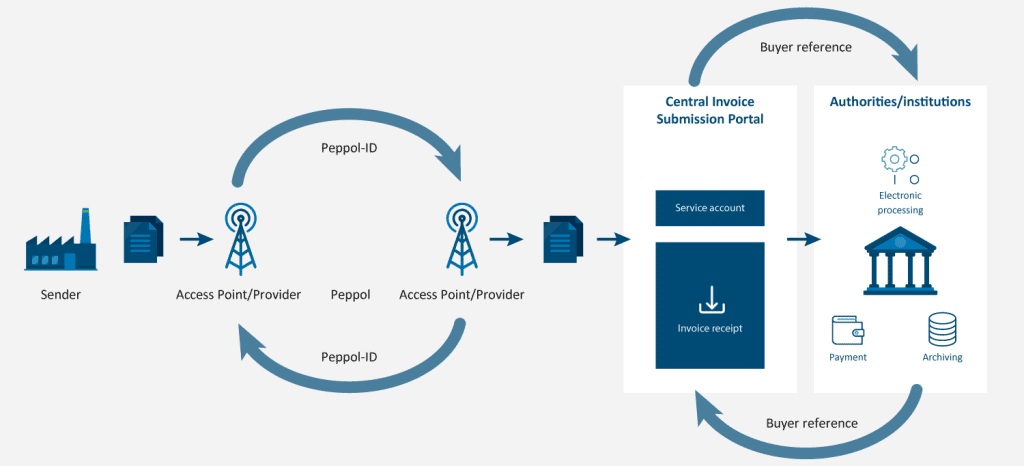
Source: Federal Ministry of the Interior (2025)
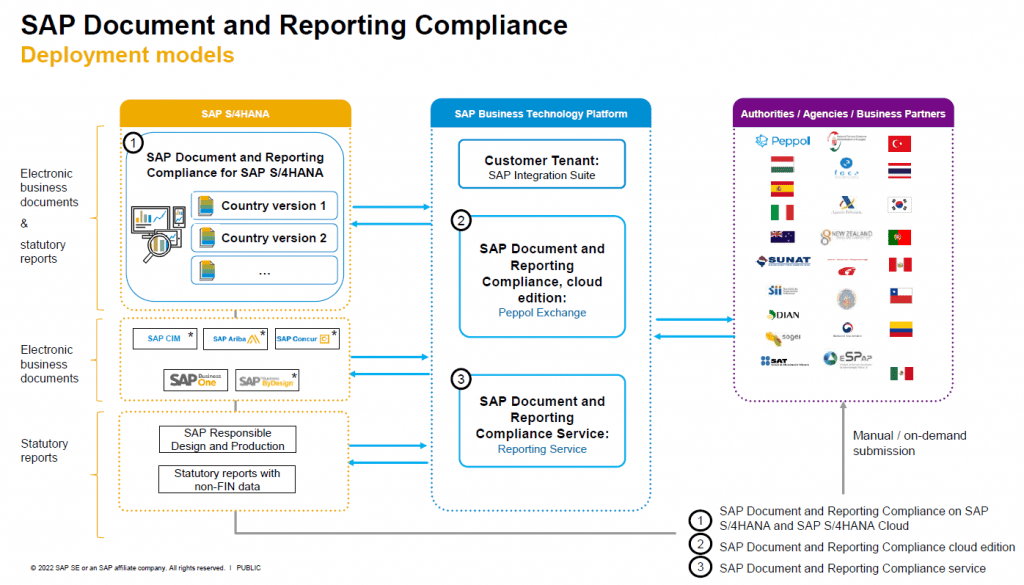
One of the most significant developments is the migration of existing compliance services to the DRC Cloud Edition. SAP aims to consolidate electronic invoicing, tax reporting, and communication with authorities on a single platform.
Key aspects of this transformation:
This transformation is not merely a technical upgrade. It represents a strategic repositioning. Compliance functions will no longer operate in isolation, but will be more strongly integrated into core transactional processes.
For companies, this means specifically:
Parallel to the technological transformation, regulatory requirements in Europe are becoming significantly stricter. The introduction of mandatory electronic invoices and the planned EU reform "VAT in the Digital Age" (ViDA) are leading to a structural realignment of VAT compliance.
Germany is gradually introducing mandatory electronic invoicing in the B2B sector. Starting in 2025, there will initially be an obligation to receive electronic invoices. In subsequent years, the obligation to issue electronic invoices will be expanded until ultimately all B2B transactions must be processed electronically. This development is not an isolated national process, but rather part of a Europe-wide trend towards standardized, digital reporting procedures.
The EU initiative ViDA goes even further. It envisions transmitting transaction data to tax authorities in near real-time. This shifts the focus from periodic reporting to continuous transaction monitoring. For companies, this means:
This regulatory dynamic increases the pressure on companies to systematically modernize and centrally manage their compliance architecture.
Outside of Germany, numerous countries are also pushing forward with mandatory electronic invoicing and reporting systems. In many cases, these are so-called Continuous Transaction Controls (CTC), where transactions must be validated or pre-approved in near real time. The individual countries are pursuing different regulatory approaches, ranging from centralized government clearance systems and reporting models to network-based transmission structures. The following overview presents selected European initiatives and their basic design.
| Country | System | Preface | characteristics |
| Germany | B2B e-invoicing obligation | 2025–2028 | Structured format (XRechnung, ZUGFeRD), no clearance system |
| Poland | KSeF | from 2026 | Clearance system via central government platform |
| France | E-Invoicing & E-Reporting | from 2026 | Hybrid model (PDP + government portal) |
| Belgium | Peppol | from 2026 | Network-based invoice transmission |
| Italian | SDI | already mandatory | Central validation by the tax authority |
| Spain | VeriFactu | gradually | Reporting model with near real-time transmission |
Parallel national initiatives are leading to an increasing fragmentation of regulatory requirements, while at the same time the need for technical standardization within corporate systems is growing. For internationally operating companies, this means that national compliance requirements must be increasingly integrated into global IT and process architectures. Platform solutions such as SAP Document and Reporting Compliance (DRC) They can act as a central integration layer, through which different national reporting requirements can be implemented in a standardized way.
In addition to regulatory requirements, SAP's technological roadmap significantly shapes the further development of DRC. The platform is increasingly being positioned as an integral component of cloud-based ERP architectures.
Furthermore, SAP is working on intelligent functions for data validation and error analysis. The goal is to identify compliance risks early and address deviations system-wide. This transforms DRC from a reactive reporting solution into a proactive management tool within the financial architecture.
The developments described above are leading to a fundamental reassessment of the role of compliance technology. Companies are not only facing technical migrations, but also a structural transformation of their tax and reporting processes. Particularly in the context of S/4HANA transformations, DRC is gaining strategic importance. If compliance is not integrated early on, subsequent adaptation costs and operational risks will arise. Furthermore, the increasing regulatory dynamism is driving the need for clear governance structures. Companies must define how regulatory changes are identified, assessed, and implemented within their systems. In addition, responsibility is increasingly shifting from purely operational departments to interdisciplinary teams from IT, tax, and finance. Compliance is thus becoming a strategic management issue and no longer merely an administrative obligation.
Best practices from transformation projects show that early strategic integration of DRC into the ERP roadmap significantly reduces implementation risks.
In the coming years, a further expansion of mandatory real-time reporting models is expected. National initiatives will increasingly be complemented by harmonized European initiatives. At the same time, SAP will consistently expand its cloud strategy and further standardize compliance functionalities. The role of DRC will continue to evolve from a purely localization and reporting solution to a global compliance integration layer. Companies that define a consistent target architecture early on can not only meet regulatory requirements but also use them as a lever for process standardization and increased efficiency.
Recent developments surrounding SAP Document and Reporting Compliance illustrate that companies are undergoing a phase of structural reorganization of their compliance architecture. The migration to cloud-based solutions, mandatory e-invoicing regulations, and the ViDA initiative are fundamentally changing the requirements for financial and tax processes. SAP DRC should therefore no longer be viewed as an isolated reporting tool, but rather as a strategic component of modern ERP and tax technology architectures. An early, systematic roadmap is crucial to minimizing regulatory risks while simultaneously realizing sustainable efficiency gains.
With the introduction of IFRS 16 Lease accounting has fundamentally changed. Lessees are now required to recognize almost all lease agreements on their balance sheet – with a right-of-use asset on the asset side and a corresponding lease liability on the liability side. For many companies, this means significantly greater complexity in processes, data management, and valuation.
SAP S / 4 HANA provides with SAP RE-FX (Flexible Real Estate Management) and SAP Contract and Lease Management (CLM) Two established approaches are available for implementing IFRS 16 in a compliant, integrated, and audit-proof manner. This article provides a structured overview of both options, their application scenarios, and decision criteria from a consultant's perspective.
IFRS 16 sets clear professional and technical requirements for IT systems:
SAP S/4HANA does not address these requirements via a separate module, but rather integrates IFRS 16 deeply into existing contract, asset and financial processes.
SAP RE-FX This is the classic SAP module for managing real estate and leases. It is particularly suitable for companies with a high proportion of... Real estate and land leasing, such as:
SAP RE-FX offers extensive standard functions for IFRS 16 mapping:
The activation of IFRS 16 logic is achieved via valuation rules and valuation areas, so that parallel accounting standards (e.g., German Commercial Code (HGB), IFRS) can be mapped.
SAP CLM CLM is the strategic SAP solution for the central management of all types of leasing and contractual relationships. Its modular design makes CLM particularly attractive for companies with heterogeneous leasing portfolios, e.g.:
SAP CLM was explicitly developed with IFRS 16 in mind and offers:
SAP CLM is fully S/4HANA optimized and uses modern data models and Fiori interfaces.
Decision criteria for using SAP RE-FX or SAP CLM can include the focus of the type of leasing, the company's orientation, and the SAP technology already in use.
If both real estate and fixed asset leasing exist, a combination of SAP RE-FX for real estate leasing and SAP CLM for other leasing contracts may be useful.
IFRS 16 with SAP RE-FX (Flexible Real Estate Management), if:
IFRS 16 with SAP CLM (Contract and Lease Management), if:
| Criterion | SAP RE-FX | SAP CLM |
| main emphasis | Real estate leasing | All types of leasing |
| Features | Very deep for real estate | Broader, more flexible approach |
| Customizing | High | Medium |
| SAP's future focus | Stable | Strategically prioritized |
| Recommended for | Real estate-intensive companies | Heterogeneous leasing portfolios |
Regardless of the chosen module, the following points are crucial:
SAP S/4HANA provides powerful tools to implement IFRS 16 efficiently, transparently and in an audit-proof manner. SAP RE-FX impresses with its depth in real estate leasing, while SAP CLM It scores points as a flexible, future-oriented solution for a broad leasing portfolio.
The right module strategy is less a technical decision than a strategic one. A thorough analysis of the leasing landscape and experienced SAP consulting are key to a sustainable and audit-proof IFRS 16 implementation.