Consulting
Experience
Expertise in Finance, Accounting & IT
Release 2508 introduces new functionality that enables the automated capture of control data for transaction-based capital consolidation using substitution rules. Specifically for integrated companies, this substitution rule feature offers the advantage of eliminating the need to create manual documents for adding capital consolidation activities.
The new release includes a large number of standard substitution rules. These are automatically activated and can be deactivated if needed. It is also possible to create your own custom substitution rules.
The following control fields can be taken into account in the substitution rules:
1.) Capital consolidation activity
2.) Upper unit
3.) Participation unit
To create a new substitution rule, open the "Manage Substitution and Validation Rules" app. When creating the rule, select the relevant business context "Fields for Capital Consolidation Control in Group Reporting".
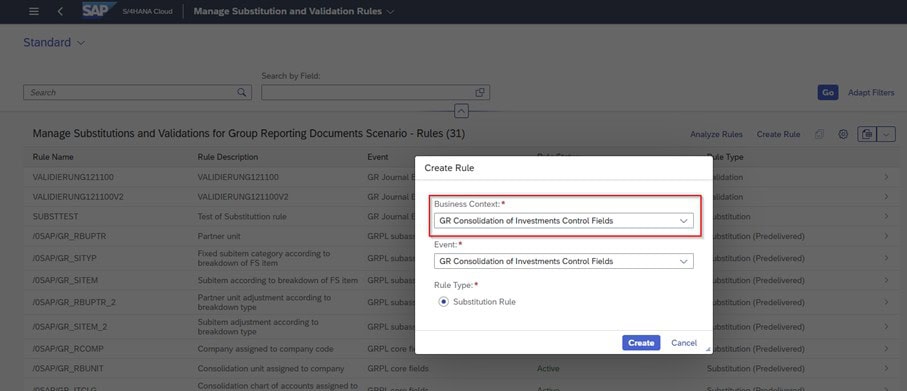
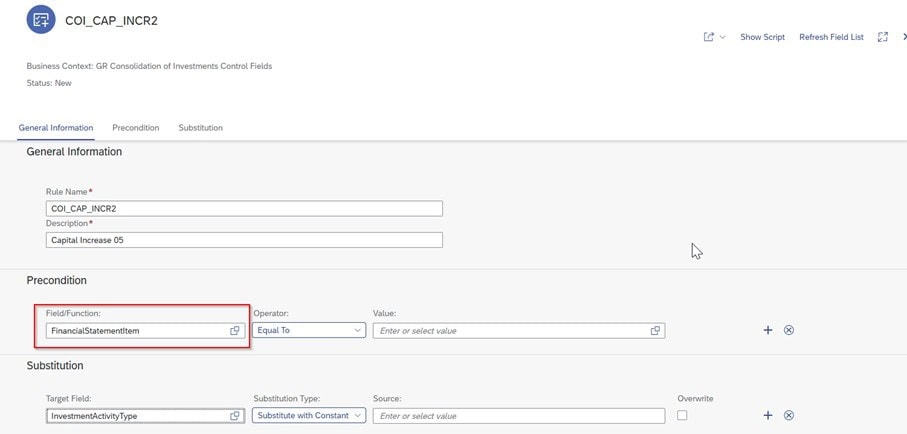
A wide variety of parameters can be selected as preconditions. These include the position, the business period, the document type, the sub-position, and many more.
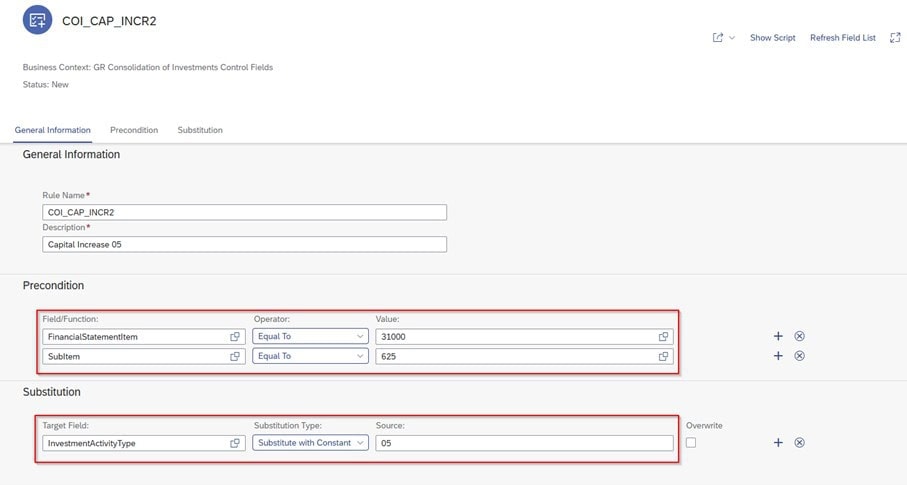
In this example, a capital position in combination with sub-position 625, used for capital increases, must be set as a prerequisite. In the substitution section, the capital consolidation activity 05 (capital increase) must be inserted.
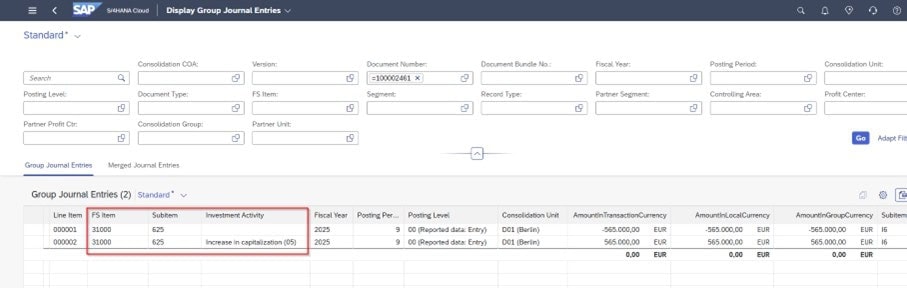
In the "View Group Accounting Documents" app, after uploading the additional reporting data, it can be seen that the capital consolidation activity 05 (capital increase) was automatically set by the substitution rule.
The solution offers several advantages:
On the other hand, the following disadvantages/challenges may arise:
And finally ...
The new ABCOI automation only offers an advantage if the accounting data is already in a consolidation-compliant structure. Incorrect classifications or missing sub-items completely prevent derivation and necessitate manual corrections in operational accounting. Therefore, the quality of the derived control data remains directly dependent on the quality, completeness, and technically correct allocation of the underlying accounting information.