Consulting
Experience
Expertise in Finance, Accounting & IT

Companies today produce more data than ever before – but fragmentation, silos, and redundant logics are slowing down operational decisions. SAP Business Data Cloud (BDC) This creates a uniform regulatory framework:
The result: Less complexity. More speed. Clear responsibilities. Future-proof data products.
Why BDC? – Explained in three sentences
The SAP Business Data Cloud (BDC) here does not mark another technological trend, but rather a necessary architectural framework to facilitate the convergence of analytics, planning, and Vision Intelligence (AI) to make it manageable.
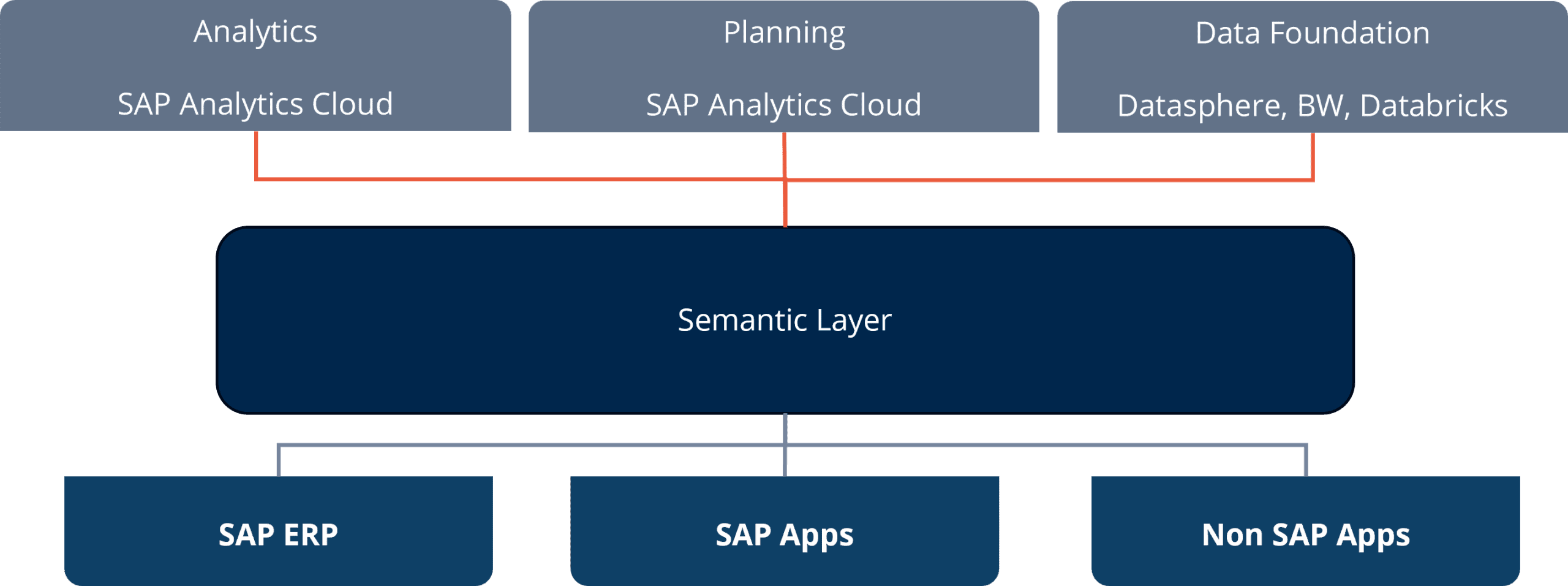
The core of the Business Data Cloud is a fundamental shift in concept: a break with traditional BW thinking. Instead of "managing" data in rigid technical objects like aDSOs or CompositeProviders, the BDC relies on the principle of Data Products.
What defines a Data Product in the BDC era?
A data product is not merely a dataset, but a contractually defined data offering:
A common misconception is that the Business Data Cloud (BDC) replaces existing SAP investments. In fact, it serves to secure existing systems while simultaneously scaling and expanding analytical capabilities.
BDC Cockpit
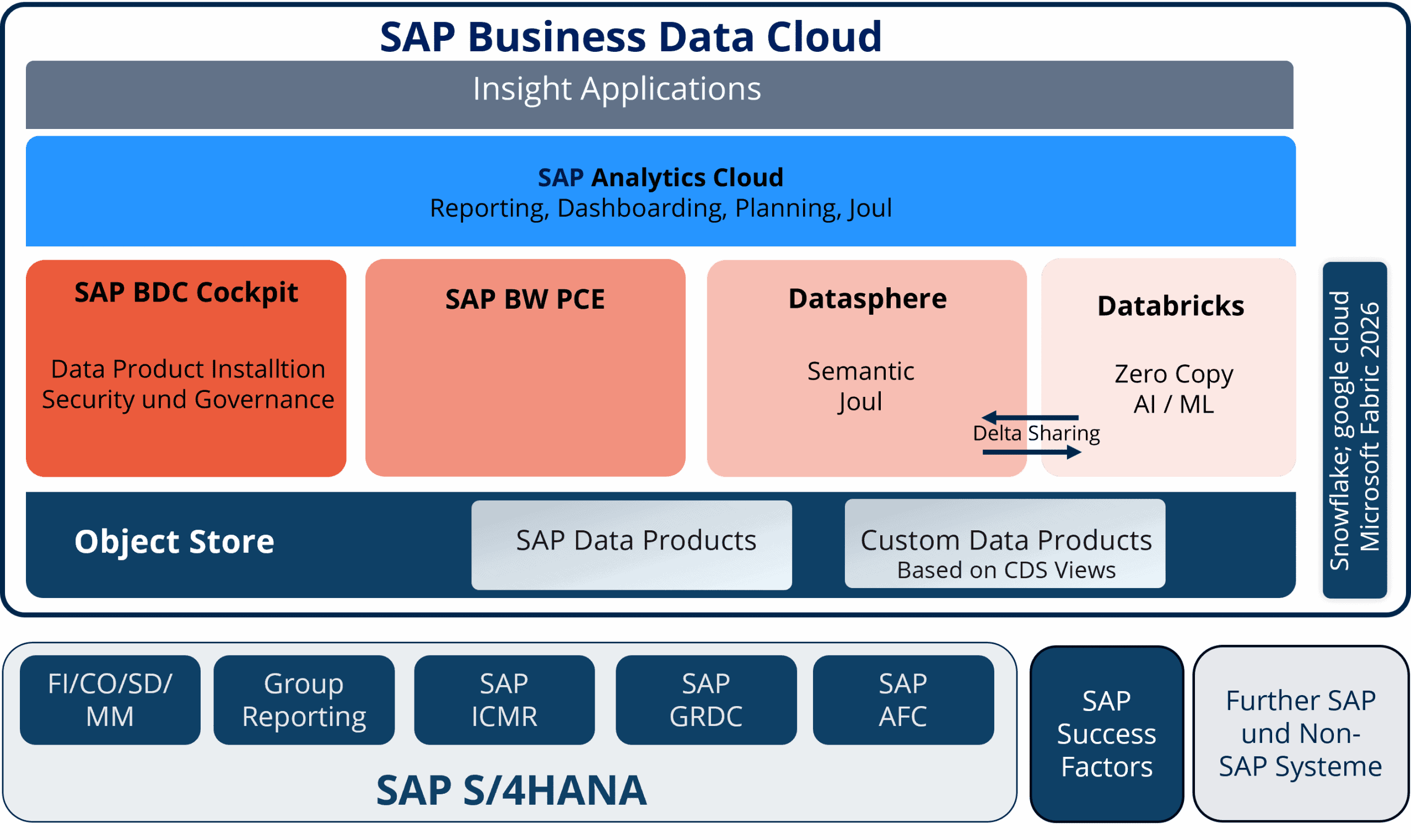
The central control unit for administration, managing inside app subscriptions, and permissions management. It provides an overview of data flows and integrations between BW/4HANA, Datasphere, SAC, and Databricks, thus ensuring a consistent and governance-compliant data landscape.
SAP Datasphere
DataSphere acts as the central semantic integration layer. Here, data from S/4HANA, BW, and non-SAP sources is harmonized. Business logic is made cloud-ready in this layer, enabling companies to obtain flexible, consistent data models for reporting and analysis.
SAP Analytics Cloud (SAC)
SAP Analytics Cloud serves as a self-service and planning platform. It enables business users to create reports, dashboards, and planning models directly on harmonized data. SAC supports both the visualization and analysis of data from BW/4HANA, Datasphere, and external sources – while maintaining governance and semantic consistency.
Databricks
Databricks is seamlessly integrated to enable advanced analytics and machine learning (pro-code) without creating new data silos. SAP continues to take the lead in semantics and governance, while Databricks serves as a powerful engine for data-intensive AI scenarios.
SAP BW/4HANA (PCE)
BW/4HANA remains the stable, transaction-oriented layer for historical data and structured core processes. It continues to form the basis for central data storage, but is no longer the sole semantic core.
Conclusion: SAP Business Data Cloud is the foundation for a future-proof data architecture. Those who use it consciously transform distributed data sets into reliable decision-making tools and measurably increase the speed of innovation.
With our SAP Business Data Cloud Service, companies operationalize their data across all systems, processes, and departments. We combine integration, modeling, and usage into a seamless data stream – extending to analytics, planning, and AI.
Standardized data products and robust semantic models ensure that data remains technically correct, consistent, and audit-proof. This creates a reliable foundation for management, analysis, and strategic decisions that grows with future requirements.
Provide orientation. Clarify architecture. Make well-informed decisions.
Many companies are currently facing similar challenges when it comes to their data and analytics strategy in the SAP environment. Fundamental questions often arise: What will happen to the existing SAP BW system in the future? In which scenarios does SAP DataSphere actually offer added value? How can new data silos be avoided when using multiple platforms in parallel? And which use cases can be realistically implemented in the short and long term? The question of how artificial intelligence can be meaningfully integrated into an existing data architecture is also gaining increasing importance.
SAP Business Data Cloud Workshop
This is precisely where our SAP Business Data Cloud Workshop comes in. The goal is to support companies in classifying their existing data and system landscape, answering architectural questions in a structured manner, and creating a sound basis for future decisions.
Who is the workshop suitable for?
This workshop is aimed particularly at companies that already use SAP BW or BW/4HANA and want to plan their future data strategy. Organizations already working with SAP Datasphere or SAP Analytics Cloud, but who have not yet developed a holistic architecture and usage concept, will also benefit. Furthermore, the workshop is suitable for companies facing strategic decisions regarding cloud, analytics, or AI initiatives and seeking an independent assessment of their architecture.
your added value
The workshop brings clarity to an environment often dominated by buzzwords and new technologies. Instead of isolated tool discussions, the focus is on a holistic architectural analysis. Companies gain a sound basis for decision-making, enabling them to systematically develop their data strategy – instead of investing in individual experiments.
SAP Business Data Cloud
When properly classified, cleanly planned and sensibly used, the SAP Business Data Cloud can play a central role in a modern data architecture and help companies to use their data more efficiently and create new added value.
This is how the workshop will proceed
1. Initial consultation (45 minutes, free of charge)
We'll clarify together:
→ Outcome: Focus & Goals for the Workshop
2nd Workshop (½ day)
Together we will develop:
Status quo & challenges
Clear classification of the BDC
Options & Target Architectures
Use case evaluation
3. Result & Recommendation
You receive: